

Bill To Ship To Under GST: Meaning, Section 10(1)(b), Examples & Case Laws (2026 Guide)
The concept of “Bill To – Ship To” under GST is one of the most important yet commonly misunderstood provisions in Indian taxation. It applies in situations where goods are invoiced to one party but physically delivered to another.
This article provides a legally verified, practical, and updated explanation of Bill To Ship To transactions under GST, along with examples, case laws, compliance requirements, and FAQs.
Example of Bill To Ship To under GST: The diagram below explains how Section 10(1)(b) works in real-life transactions.
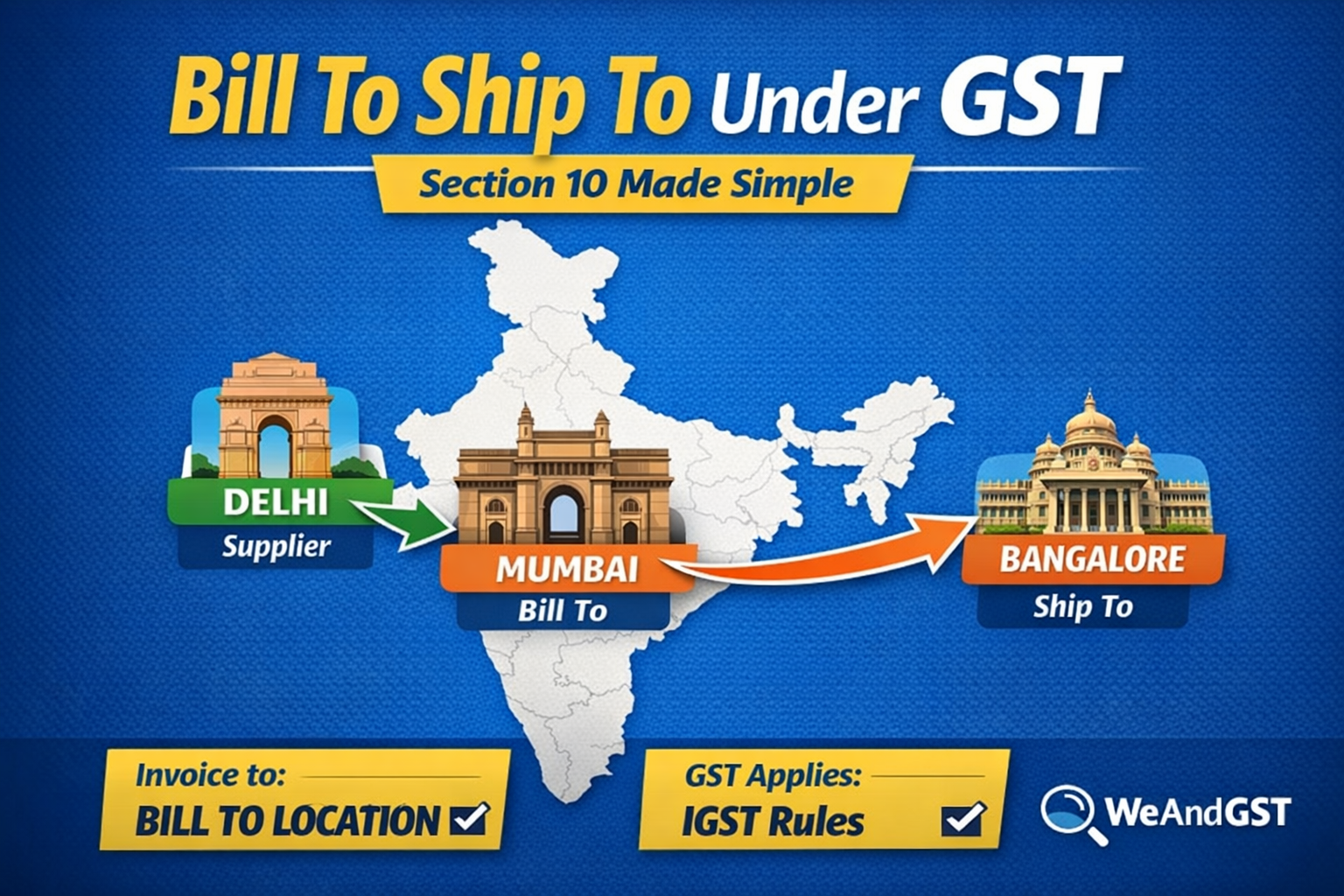
As shown above, GST is applied based on the Bill To location (Mumbai), even though goods are delivered to Bangalore.
📌 What is Bill To Ship To Under GST?
A Bill To – Ship To transaction occurs when:
- The invoice is raised to one person (Bill To party), but
- The goods are delivered to another person (Ship To party)
In simple terms:
Invoice goes to Party A, but goods go to Party B.
This is common in:
- E-commerce transactions
- Corporate procurement structures
- Job work arrangements
- Third-party logistics (3PL)
⚖️ Legal Provision Under GST
This concept is governed by Section 10(1)(b) of the IGST Act, 2017.
“Where goods are delivered by the supplier to a recipient or any other person on the direction of a third person… it shall be deemed that the said third person has received the goods.”
Legal Interpretation:
- The “Bill To” party is treated as the recipient of goods
- Place of supply is determined based on the Bill To party
📦 Practical Example (Step-by-Step)
Scenario:
- Supplier: Delhi
- Bill To: Company A (Mumbai)
- Ship To: Company B (Bangalore)
Transaction Flow:
- Supplier raises invoice to Company A (Mumbai)
- Goods are shipped directly to Company B (Bangalore)
- Company A records purchase and may further invoice Company B
Key Point: GST is charged based on the location of Company A (Bill To), not delivery location.
📍 Place of Supply (Most Critical Concept)
Under Section 10(1)(b):
Place of Supply = Location of Bill To Party
| Particular | Location |
|---|---|
| Supplier | Delhi |
| Bill To | Mumbai |
| Ship To | Bangalore |
| Place of Supply | Mumbai |
Result: IGST will be charged.
💡 GST Treatment Explained
- The supplier charges IGST to the Bill To party
- The Bill To party is eligible to claim Input Tax Credit (ITC)
- No second GST is charged on the same movement of goods
This ensures no double taxation in the supply chain.
🧾 Invoice Requirements (As per GST Law)
The invoice must clearly mention:
- Bill To Name, Address & GSTIN
- Ship To Name and Address
- Place of Supply
- Applicable GST (IGST or CGST+SGST)
Note: Incorrect invoice details can lead to ITC denial.
⚠️ Common Mistakes to Avoid
- Charging GST based on delivery location
- Ignoring Section 10(1)(b)
- Not mentioning Ship To details in invoice
- Treating it as two separate taxable supplies
🏛️ Important Case Laws & Rulings
1. Columbia Asia Hospitals Pvt. Ltd. (AAR Karnataka)
This ruling clarified that transactions involving multiple locations within the same entity must be evaluated carefully for GST implications.
Relevance: It reinforced the importance of identifying the actual recipient under GST provisions.
2. Tata Steel Ltd. (AAR Odisha)
The authority examined supply involving third-party delivery and confirmed that:
- The Bill To party is considered the recipient
- Place of supply is based on the Bill To party
3. Kansai Nerolac Paints Ltd. (AAR Maharashtra)
This ruling supported the principle that delivery to a third party on instructions of the buyer qualifies under Section 10(1)(b).
Key Takeaway: GST liability depends on contractual direction, not physical delivery alone.
📊 Real-Life Business Scenarios
1. E-Commerce Model
A company orders goods for its branch or client — billing is done centrally, delivery elsewhere.
2. Corporate Procurement
Head office purchases goods but sends directly to factory/branch.
3. Job Work Transactions
Principal sends goods directly to job worker via supplier.
4. Third-Party Logistics (3PL)
Goods delivered to customer warehouses via logistics partners.
📦 E-Way Bill Implications
E-way bill is required based on movement of goods.
- “Bill To” and “Ship To” details must be correctly entered
- Mismatch may lead to penalties
🔍 FAQs (SEO + Featured Snippet Optimized)
❓ Is GST charged twice in Bill To Ship To transactions?
No, GST is charged only once based on the Bill To party.
❓ Who can claim Input Tax Credit (ITC)?
The Bill To party (invoice holder) can claim ITC.
❓ Can place of supply be Ship To location?
No, under Section 10(1)(b), place of supply is always the Bill To location.
❓ Is e-way bill mandatory?
Yes, if applicable based on value and movement of goods.
❓ What happens if invoice is incorrect?
Incorrect invoicing can lead to ITC denial, penalties, and compliance issues.
🚀 Expert Tip
Always remember:
GST follows the “Bill To” party — not the delivery location.
📌 Conclusion
The Bill To Ship To concept under GST ensures seamless taxation in multi-party transactions while avoiding double taxation.
Understanding Section 10(1)(b) is crucial for:
- Correct GST charging
- Proper ITC claims
- Avoiding notices and penalties
Businesses must ensure proper documentation, invoicing, and compliance to fully benefit from this provision.
📢 Disclaimer
This article is based on provisions of the IGST Act, 2017, relevant rules, and judicial interpretations available as of 2026. It is intended for educational purposes and should not be considered legal advice. Professional consultation is recommended for specific cases.
🔗 Related GST Guides (Must Read)
GST Invoice Format Guide (With Excel Templates)
E-Way Bill Rules Explained (Latest 2026 Update)
Place of Supply Under GST (Complete Guide)
IGST vs CGST vs SGST – Key Differences Explained
Input Tax Credit (ITC) Rules – Eligibility & Conditions
💡 Pro Tip: Understanding these guides will help you avoid GST notices and ensure 100% compliance in Bill To Ship To transactions.
Permalink